Inaccurate flow data isn’t a meter error; it’s a direct threat to your project’s profitability and viability.
For engineers and plant managers operating dairy waste digesters, biogas is the ultimate output metric. It is the measure of process efficiency, the source of renewable energy, and the foundation for revenue from carbon credits or power generation. However, this entire value chain depends on a single, critical factor: the absolute accuracy of the gas flow data. Relying on inaccurate measurement is not an option; it is a fundamental operational risk.
The environment within a biogas pipeline is uniquely hostile to measurement instruments. The gas is saturated with water vapor, contains abrasive particulates, and carries corrosive elements like hydrogen sulfide (H2S). Furthermore, the low line pressure and variable flow rates common in digesters present significant challenges for many meter technologies. Diaphragm meters can clog and fail. Orifice plates are prone to blockage and require complex corrections for changing gas composition and pressure as well as high pressure drop. These traditional methods often produce data that is, at best, an estimate, and at worst, dangerously misleading.
The financial and operational costs of this inaccuracy are severe. Without a precise Biogas Flow Meter, you cannot:
-
Validate Process Efficiency: You cannot accurately correlate feed stock input to methane output. A drop in yield, the first sign of process imbalance, goes undetected until it becomes a major problem.
-
Secure Revenue: Carbon credit programs and renewable energy certificate (REC) schemes require auditable, precise gas volume data. Estimation is rejected. Inaccurate data directly translates to lost revenue and failed audits.
-
Ensure Operational Safety: An unmeasured or under-reported flow of flammable methane gas represents a significant safety oversight. Accurate monitoring is a cornerstone of facility safety protocols.
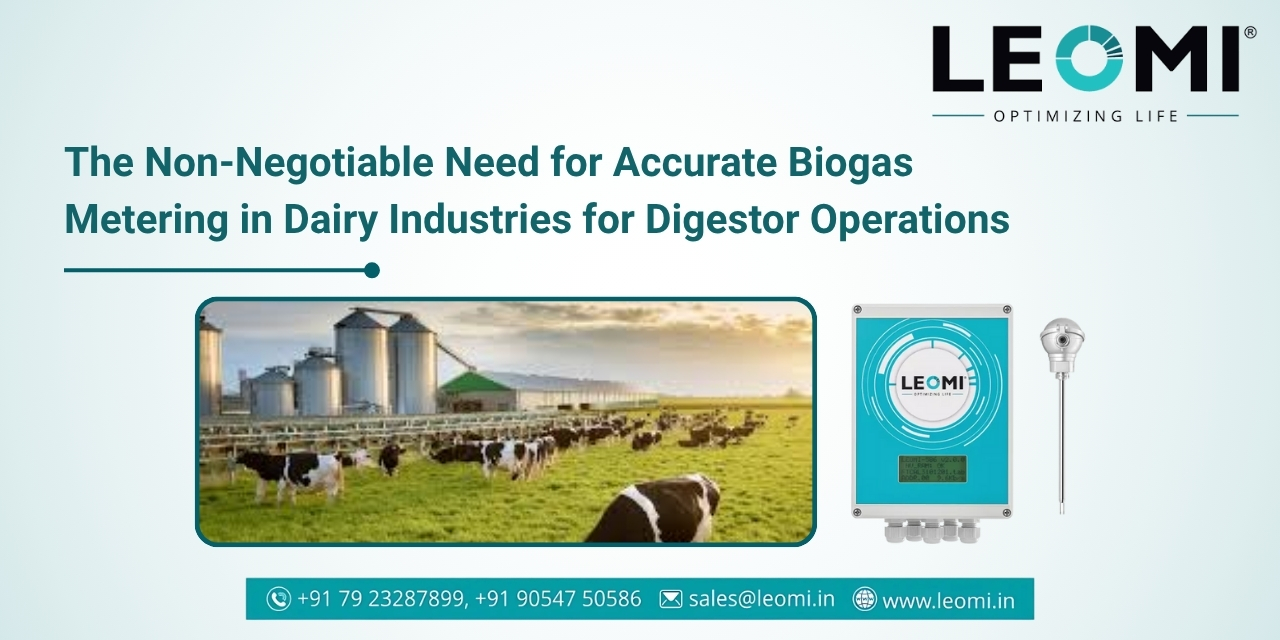
The solution is a meter specifically engineered for this application, not adapted to it. Thermal mass flow meter technology, such as the solutions provided by Leomi, is designed to overcome the specific challenges of biogas.
A thermal mass Biogas Flow Meter operates on the principle of heat transfer. It measures the cooling effect of the heated sensor due to gas flow, which provides a direct reading of mass flow rate. This methodology offers several critical advantages after dairy digesters:
-
Mass Flow Measurement: It measures the actual mass of gas flowing, not its volume. This is crucial because the energy content of biogas is a function of mass (specifically, the mass of methane). Volumetric meters require constant temperature and pressure compensation to approximate mass flow, introducing error. A thermal mass meter provides the correct data directly.
-
Robustness Against Harsh Conditions: High-quality meters are built with 316 stainless steel or Hastealloy C276 wetted parts, offering inherent resistance to corrosion from H2S and moisture. Their design incorporates no moving parts, eliminating a primary point of mechanical failure and preventing clogging from moisture slugs or particulate matter. This design ensures continuous, reliable operation with minimal maintenance.
-
Low Pressure Drop and High Turndown: These meters operate effectively at the low pressures present after digester systems and can accurately measure across a wide range of flow rates, from low production periods to peak output.
Implementing a dedicated, accurate Biogas Flow Meter transforms digester management from a process of estimation to one of precise control. It provides the definitive data required to:
-
Troubleshoot and optimize the anaerobic digestion process in real-time.
-
Generate irrefutable reports for regulatory compliance and carbon credit verification.
-
Safeguard the operational integrity and financial return on investment of the entire waste-to-energy system.
In conclusion, the selection of a flow meter is a critical technical decision, not a mere procurement checkmark. For a dairy digester, opting for anything less than a meter specifically designed for biogas is a compromise that risks the entire project’s economics. Accurate measurement is not a cost; it is the foundation for profitability, safety, and sustainability.