Where It Fits and How It Compares with Common Flow Measurement Technologies
Industrial plants rely on Air Pollution Control (APC) systems—such as baghouses, wet scrubbers, electrostatic precipitators, and thermal oxidizers—to control emissions and comply with environmental regulations. A critical yet often overlooked aspect of these systems is accurate gas flow measurement.
Gas flow measurement in APC systems helps operators:
- Monitor stack emissions
- Optimize scrubber performance
- Ensure proper air distribution
- Track energy consumption
- Maintain regulatory compliance
However, measuring gas flow in APC environments is challenging because of large ducts, low velocities, dust-laden gases, and uneven flow profiles. This is where thermal mass flow measurement technology is increasingly being explored.
In this article, we look at where gas flow measurement is needed in APC systems and how thermal mass flow meters compare with commonly used technologies.
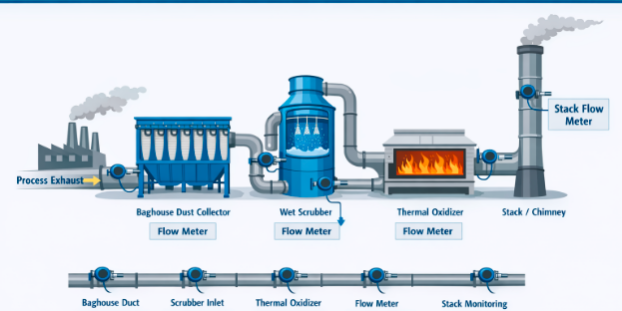
Where Gas Flow Measurement Is Used in APC Systems
APC systems often require gas flow monitoring at several key points.
1. Stack / Flue Gas Monitoring
Flow measurement in stacks is essential for calculating total mass emissions and ensuring compliance with environmental standards.
2. Baghouse / Dust Collector Ducts
Baghouses filter particulate matter from process gases. Monitoring airflow helps ensure proper filtration performance and system balance.
3. Wet Scrubber Systems
Wet scrubbers remove gases such as SO₂, HCl, and other pollutants. Accurate gas flow measurement ensures the correct gas-to-liquid ratio, which is critical for removal efficiency.
4. Thermal Oxidizers (RTO / TO)
Thermal oxidizers destroy VOCs and hazardous air pollutants. Monitoring gas flow ensures stable combustion conditions and efficient pollutant destruction.
5. Industrial Ventilation and Exhaust Systems
Many APC systems also manage process ventilation and exhaust ducts, where airflow monitoring helps maintain proper system operation.
Challenges in Gas Flow Measurement in APC Systems
Unlike clean gas pipelines, APC systems present several measurement challenges:
- Large duct sizes (sometimes several meters in diameter)
- Low gas velocities
- Dust-laden or corrosive gases
- Uneven flow profiles
- Difficult installation conditions
These challenges make it difficult for traditional flow measurement technologies to provide reliable results.
Common Gas Flow Measurement Technologies in APC Systems
Several technologies are commonly used for gas flow measurement in industrial ducts.
1. Pitot Tubes / Averaging Pitot Tubes
These devices measure velocity pressure and calculate flow based on differential pressure.
Advantages
- Low initial cost
- Widely used and familiar technology
Limitations
- Requires multiple measurement points
- Sensitive to dust and clogging
- Performance affected by low velocities
- Requires pressure and temperature compensation
2. Orifice Plates
Orifice plates create a pressure drop in the flow and measure differential pressure to determine flow rate.
Advantages
- Simple design
- Established technology
Limitations
- Creates permanent pressure loss
- Requires long straight pipe runs
- Not ideal for large ducts or dirty gases
- Accuracy affected by process conditions
3. Ultrasonic Flow Meters
Ultrasonic meters measure flow using the transit time of ultrasonic signals across the gas stream.
Advantages
- No pressure drop
- Suitable for large pipes
Limitations
- Performance can be affected by dust, moisture, and turbulence
- Installation can be complex in large ducts
- Higher cost
4. Vortex Flow Meters
Vortex meters measure flow based on the vortices created by a bluff body placed in the flow path.
Advantages
- Good for clean gas flows
- Stable measurement under certain conditions
Limitations
- Requires minimum flow velocity
- Not suitable for very low gas flows or large ducts
- Sensitive to vibration and turbulence
Thermal Mass Flow Meters
Thermal mass flow meters measure flow by detecting heat transfer from a heated sensor to the flowing gas. Because the heat transfer depends on the mass flow rate, the meter can measure gas flow directly without requiring pressure or temperature compensation.
Key Advantages
- Direct mass flow measurement
- Works well in large ducts and pipes
- Effective for low gas velocities
- No pressure drop
- Minimal maintenance
- Suitable for dust-laden gases
These characteristics make thermal mass flow meters particularly attractive for APC applications.
Technology Comparison
| Technology | Pressure Drop | Low Velocity Performance | Suitability for Large Ducts | Maintenance | Sensitivity to Dust |
| Pitot Tube | None | Moderate | Good | Medium | High |
| Orifice Plate | High | Moderate | Limited | Medium | Medium |
| Ultrasonic | None | Good | Good | Low | Medium |
| Vortex | Low | Poor | Limited | Medium | Medium |
| Thermal Mass | None | Excellent | Excellent | Low | Low |
Why Thermal Mass Flow Measurement Is Gaining Interest in
APC Systems
As industries face stricter environmental regulations and higher energy costs, operators need better visibility into gas flow within pollution control systems.
Thermal mass flow measurement offers several benefits:
- Improved monitoring of emission systems
- Better energy management in air handling systems
- Reliable measurement in large ducts and low-velocity gas streams
- Reduced maintenance compared with differential pressure systems
Because of these advantages, many APC equipment manufacturers and plant operators are exploring thermal mass flow technology as an alternative or complement to traditional measurement methods.
Conclusion
Accurate gas flow measurement plays a crucial role in ensuring that air pollution control systems operate efficiently and comply with environmental regulations.
While technologies such as pitot tubes, orifice plates, ultrasonic meters, and vortex meters continue to be used, thermal mass flow measurement provides a compelling option for applications involving large ducts, low gas velocities, and challenging gas conditions.
As industrial facilities continue to focus on efficiency, emissions monitoring, and operational reliability, thermal mass flow meters are becoming an increasingly valuable tool for modern APC systems.