Choosing between an insertion thermal mass flow meter and an inline thermal mass flow meter is one of the most important decisions when designing or upgrading a gas flow measurement system. While both technologies operate on the same thermal dispersion principle and measure mass flow directly, their installation methods, applications, and costs differ significantly.
Selecting the right design depends on factors such as pipe size, installation requirements, maintenance accessibility, and measurement accuracy. This guide compares both options to help engineers and plant professionals make an informed decision.
Understanding Thermal Mass Flow Meters
A thermal mass flow meter measures the mass flow rate of gases by monitoring the amount of heat transferred from a heated sensor to the flowing gas. Since the measurement is based on heat transfer, it directly measures mass flow without requiring separate temperature or pressure compensation under normal operating conditions.
These instruments are commonly used for measuring:
- Compressed Air
- Natural Gas
- Nitrogen
- Oxygen
- Biogas
- Flare Gas
- Combustion Air
- Process Gases
The main difference lies not in the measuring principle but in how the meter is installed within the pipeline.
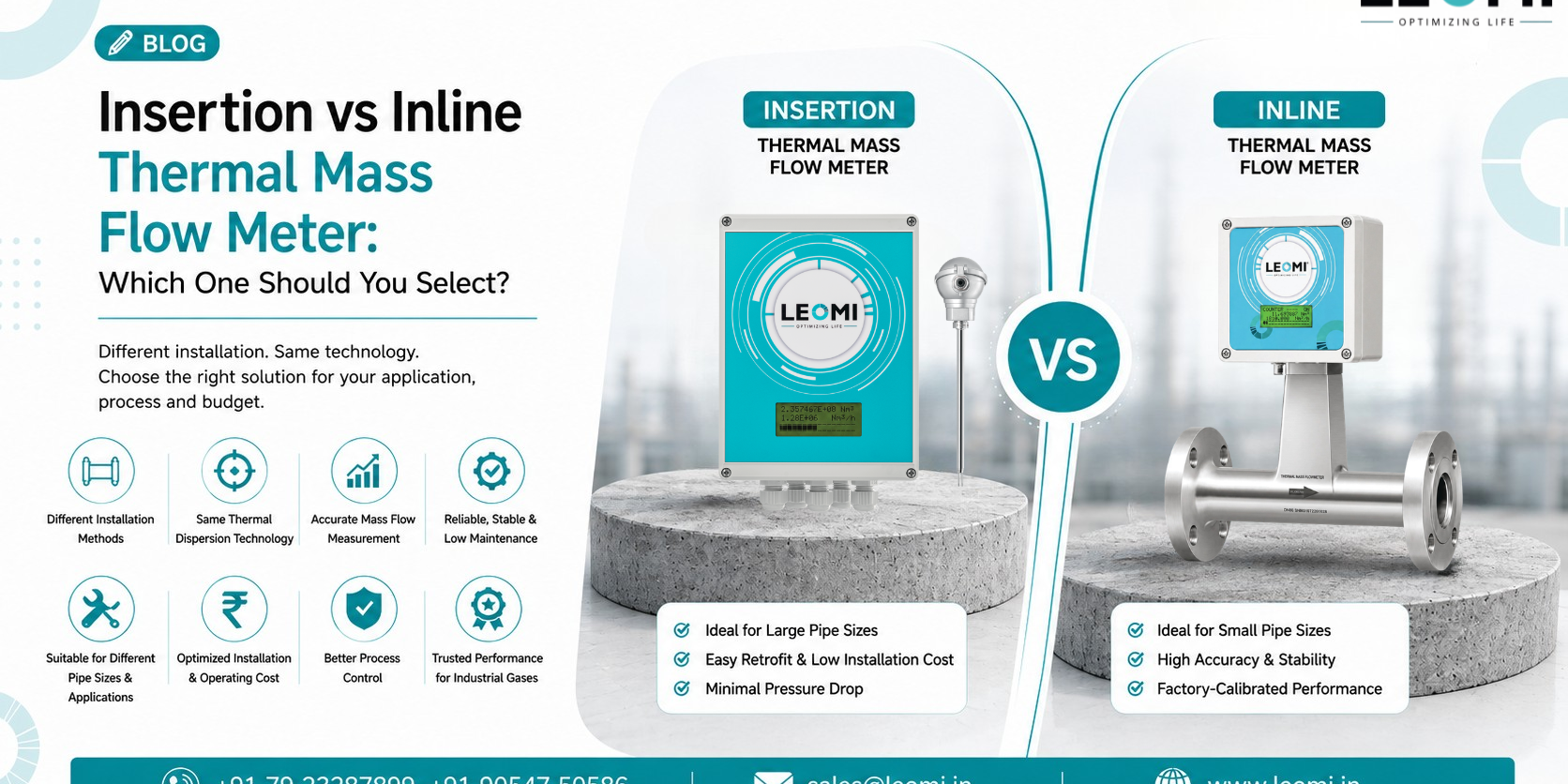
What Is an Insertion Thermal Mass Flow Meter?
An insertion thermal mass flow meter is installed through a fitting, allowing the sensing probe to extend into the gas stream without replacing an entire section of pipe.
It is widely used in medium and large-diameter pipelines where installing a full inline meter would be expensive or impractical.
Typical Applications
- Compressed air distribution systems
- Industrial utility lines
- Aeration systems
- Boiler combustion air
- Large process gas pipelines
- Flue gas monitoring
Advantages
- Suitable for large pipe diameters
- Lower installation cost for existing pipelines
- Easy retrofit into operational systems
- Lower pressure drop
- Ideal for utility gas monitoring
Considerations
- Requires correct insertion depth
- Proper sensor positioning is important
- Straight pipe lengths should be maintained for best accuracy
What Is an Inline Thermal Mass Flow Meter?
An inline thermal mass flow meter is installed as part of the pipeline. The entire flow passes through the meter body, allowing the sensors to measure the complete gas stream.
This design is generally preferred for smaller pipe sizes and applications requiring highly controlled flow measurement.
Typical Applications
- Process control
- Laboratory systems
- OEM equipment
- Gas skids
- Pilot plants
- Small process pipelines
Advantages
- High measurement stability
- Factory-calibrated flow profile
- Simple installation for small pipelines
- Compact design
- Excellent repeatability
Considerations
- Installation requires cutting the pipeline
- Higher cost in larger pipe sizes
- Less economical for very large diameter pipelines
Key Differences Between Insertion and Inline Thermal Mass Flow Meters
| Feature | Insertion Type | Inline Type |
| Installation | Probe inserted into pipe | Installed as a complete pipe section |
| Best Pipe Size | Medium to large pipelines | Small diameter pipelines |
| Retrofit Installation | Excellent | Moderate |
| Installation Cost | Lower for large pipes | Cost-effective for small pipes |
| Pressure Drop | Minimal | Very low |
| Maintenance | Easy probe removal | May require pipeline isolation |
| Typical Use | Utilities and process monitoring | Precision process applications |
Which One Should You Choose?
The right choice depends on your application rather than the technology itself.
Choose an Insertion Thermal Mass Flow Meter If:
- Your pipeline diameter is large.
- You are upgrading an existing plant.
- Installation downtime must be minimized.
- Budget is an important consideration.
- You need continuous monitoring of utility gases such as compressed air or combustion air.
Insertion meters provide an economical solution while maintaining reliable measurement performance for industrial applications.
Choose an Inline Thermal Mass Flow Meter If:
- Your pipeline diameter is relatively small.
- The application requires precise process control.
- You are designing new equipment or skid systems.
- Factory-controlled flow conditions are preferred.
- Compact installation is important.
Inline meters are commonly selected where process accuracy and repeatability are the highest priorities.
Factors to Consider Before Selection
Before purchasing either type of thermal mass flow meter, evaluate the following:
- Gas type and composition
- Pipe diameter
- Operating pressure
- Operating temperature
- Minimum and maximum flow rates
- Installation accessibility
- Required communication outputs
- Maintenance requirements
- Calibration traceability
Reviewing these parameters helps ensure the selected meter performs reliably throughout its operating life.
Can Both Types Deliver Accurate Measurements?
Yes. Both insertion and inline thermal mass flow meters use the same measurement principle and can deliver excellent accuracy when they are correctly selected, calibrated, and installed.
Measurement performance depends more on proper application engineering than on whether the meter is insertion or inline. Factors such as sensor placement, flow profile, and installation practices play a significant role in achieving reliable results.
Final Thoughts
Both insertion and inline thermal mass flow meters offer dependable gas flow measurement, but each is designed for different industrial requirements. Insertion models are ideal for large pipelines, retrofit projects, and utility applications, while inline models are better suited for smaller pipelines and processes requiring controlled, high-accuracy measurements.
If you’re evaluating the right solution for your application, Leomi Instruments offers both insertion and inline thermal mass flow meters designed for a wide range of industrial gases. Backed by application expertise, quality calibration, and dependable technical support, Leomi helps industries select the most suitable flow measurement solution for reliable and efficient plant operation.