
Why Combustion-Air Measurement Is Critical
Thermal power plants operating on coal or alternative solid fuels depend on precise combustion-air control to achieve stable boiler performance. The air-fuel ratio determines combustion completeness, heat release per tonne of fuel, boiler efficiency and stack-emission behaviour. Maintaining the correct ratio from start-up through full-load operation requires accurate and repeatable measurement of every major combustion-air stream.
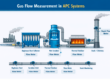
Primary air transports pulverised coal from the mills to the burners. Secondary air supports flame combustion and mixing. Overfire air controls staged combustion, reduces NOx formation and supports complete burnout. Each stream operates under different duct sizes, temperatures, velocities and process conditions, making reliable flow measurement essential for boiler control.
The Cost of Incorrect Combustion-Air Data
When airflow measurement is inaccurate, the boiler control system acts on incorrect data. Excess air lowers flame temperature, increases dry flue-gas losses and reduces boiler thermal efficiency. Insufficient air leads to incomplete combustion, higher CO, increased unburned carbon in fly ash and reduced steam generation per tonne of coal.
Emission performance is also directly affected. NOx, SOx and particulate behaviour are influenced by the distribution and control of combustion air across the operating range. As emission requirements become increasingly stringent, dependable combustion-air data is essential for process optimisation and compliance reporting.
Why Conventional DP Systems Become Difficult in Boiler Ducts
Differential-pressure devices such as airfoil meters, orifice plates, Annubar-type sensors and Pitot tubes are widely used in boiler air systems. Their performance depends on representative velocity measurement, clean pressure taps, stable density compensation and adequate straight length.
Large circular and rectangular ducts often exhibit non-uniform velocity profiles due to bends, dampers, fans and transitions. In dust-laden service, pressure taps and sensing elements may foul, causing drift and requiring maintenance. Because DP systems measure differential pressure, separate pressure and temperature inputs are generally required for mass-flow conversion, increasing the number of variables in the measurement chain.
Thermal Mass Flow Measurement Principle
Inline and insertion thermal mass flow meters operate on the thermal dispersion principle. A reference Pt100 measures the gas temperature, while a second Pt100 is heated to a controlled over-temperature. As air flows over the sensor, it removes heat. The electrical power required to maintain the temperature differential is proportional to the gas mass velocity.
The transmitter converts this calibrated thermal response into direct mass or normalised volumetric flow. This eliminates the need for separate pressure and temperature compensation transmitters and avoids compounding errors across multiple measurement signals.
Technical Advantages for Primary, Secondary and Overfire Air
- 100:1 turndown ratio for accurate measurement at start-up, part load and full load.
- Direct mass-flow measurement independent of routine pressure and temperature variations.
- Very low or negligible permanent pressure loss, with no additional fan-energy penalty.
- No moving parts in the gas stream.
- Suitability for large circular and rectangular ducts through insertion mounting.
- Retractable and cleanable sensor arrangement for dusty applications.
- 4-20 mA and digital communication for seamless DCS and SCADA integration.
- Probe material selection according to temperature, corrosion and dust characteristics.
Proven Field Performance
A documented field installation at a 200 MW captive thermal power plant in a cement complex has operated continuously for more than ten years at the ID blower fan outlet. The application measures flow up to 1,20,000 Nm³/h in a 1400 mm × 1200 mm rectangular duct without requiring maintenance intervention. This demonstrates the long-term reliability of correctly selected and installed insertion thermal mass flow technology in power-plant service.
Process and Efficiency Benefits
Reliable combustion-air data allows the air-fuel ratio to be controlled within the designed operating range across varying loads. Field-reported results from coal-fired boilers using thermal mass flow measurement include reductions in unburned carbon in fly ash of up to 50% and improvements in boiler thermal efficiency of up to 2%.
Accurate airflow data also supports overfire-air control, flue-gas recirculation and ammonia-injection SCR systems. These technologies depend on dependable flow feedback to operate as designed and deliver consistent emission-reduction performance.
LEOMI-586 for Thermal and Captive Power Applications
LEOMI Instruments manufactures the LEOMI-586 Insertion Thermal Mass Flow meter for combustion-air measurement in thermal power plants and captive power units. The instrument is applied across power, cement, steel, fertiliser and textile industries. LEOMI application engineering support includes duct sizing, velocity review, probe-material selection, installation-position planning and integration with existing DCS and SCADA platforms.